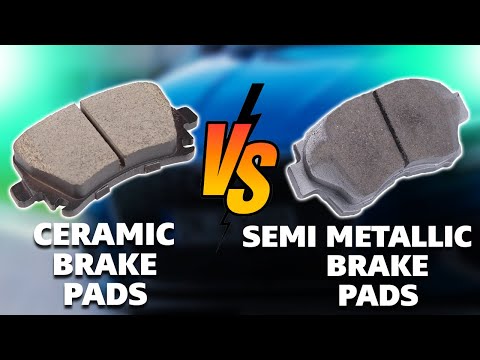
Ceramic vs Semi-Metallic Brake Pads –What’s the Difference? In this video, we will discuss the difference between Ceramic and Semi–Metallic Brake Pads and which one is better.
The Main Difference Between These Ceramic And Semi–Metallic Brake Pads Is How They Conduct Heat.
Semi–Metallic Brake Pads are made of several metals, including copper, iron, and aluminum, which are good conductors of heat. On the other hand, Ceramic Brake pads are made of ceramic with embedded copper wires. Thus, Ceramic brake pads conduct less heat, and most of the heat generated is distributed along to other braking system components.
Ceramic and Semi-Metallic Brake Pads’ Efficacy Differs Depending On Vehicle Performance.
When operating high-performance vehicles, especially those that carry heavy loads or are used in racing, you might consider having the Semi–Metallic Brake Pads. These can absorb heat well under extreme braking conditions, which is convenient for frequent heavy braking. This is because they are made of a mix of metals, which are good conductors of heat. Ceramic Brake Pad tends to act as an insulator. Although they are infused with copper wires, Ceramic is a poor conductor of heat, and most of the heat will build up.
The Two Also Differ In Terms Of Noise and Dust Release
Semi-Metallic Brake Pads are made of soft material. They do not have a firm grip on the rotors, and this results in a squealing noise. Ceramic Brake Pads are hard and achieve a firm grip on the rotors. When in use, no noise is made.
Are There Any Similarities between Ceramic and Semi-Metallic Brake Pads?The two types of brake pads are not exactly similar in any way, maybe only by function; stopping the vehicle.
To Sum Up, Which Is Better – Ceramic Or Semi-Metallic Brake Pads?
Ceramic and Semi-Metallic Brake Pads are equally useful depending on the purpose of your vehicle. If you engage in extreme driving or carry heavy loads, Semi-Metallic Brake Pads are most suited for your vehicle. On the other hand, if you engage in regular driving, Ceramic Brake Pads are most suitable since they are quiet and comfortable.
►Disclaimer◄
This video is solely intended for educational purposes only. The information presented has been thoroughly researched and sourced from reputable outlets, including, but not limited to, Google, social media platforms, and online forums. Our team has meticulously crafted original content centered around this topic, utilizing a comprehensive approach to ensure accuracy and reliability.
The Savvy Professor is a YouTube channel that provides up-to-date information on various topics, ranging from finance ,technology ,gaming, how-to tutorials, product reviews, and roundups. Our channel is dedicated to delivering informative, original, and unbiased content that viewers can appreciate.
……………………………
Content Credit :
The visual content featured in this video has been obtained from reputable sources, including Google Images, official websites, and stock footage clips.
Furthermore, the information presented in this video has been derived from various reliable data sources, such as Wikipedia, Google search, Forums and other social media platforms.
The video has been professionally edited using a combination of Adobe Premiere and Adobe After Effects, to create original content thats is engaging for our viewers.
……………………………….
FTC Disclosure: The Savvy Professor is a participant of Amazon Affiliate Program. Provided Amazon product links are linked to my Amazon Affiliate account & I receive small commissions from every successful purchase made using these links.

Wrong. Braking causes a shearing force on the pads and generates heat on the pads. Semi-metallic has higher temperature heat on metal. Whereas, the ceramic pad has a lower temperature on the ceramic pad. Therefore, the ceramic pads can take high-temperature shearing force, and be cooler, while the metallic pad has a higher temperature index overheated on the metallic pad. The ceramic pad has a lower temperature than the semi-metallic pad.
Stone has a high melting point, and metal has a lower melting point. The ceramic pad is cooler than the semi-metallic pad. The shearing force on the pad generates heat on the pad. The ceramic pad is cooler than the semi-metallic pad.
alum-mim-mum 💀
Semi metallic cons
Warped rotors
Groove rotors
Wear rotor
Boil and bubbles in brake fluid
Overheat/smoke brake
Sintered brake pads are primarily used in motorsports and high-performance sports cars due to their higher price. However, they should not be used on standard brake discs.
The combination is incompatible because the harder pad material can overload the brake discs, causing significant wear. This can lead to mechanical stress, increased heat generation, and the associated wear from overheating of the brake discs, potentially resulting in deformation and even cracking in extreme cases.
Therefore, compatible brake discs should always be used when installing sintered brake pads. This ensures optimal performance and the desired braking power, as well as guaranteeing safe braking. Using sintered brake pads with standard discs poses risks and can negatively impact braking performance. For a normal, everyday vehicle, it makes no sense unless you want to waste money unnecessarily.